


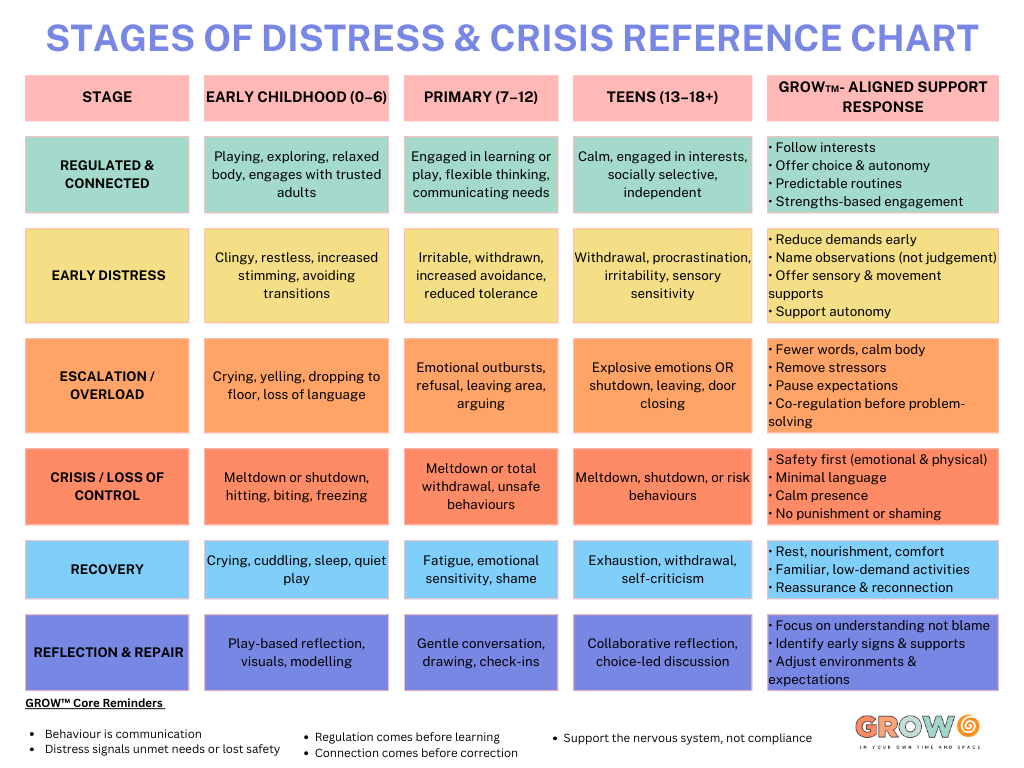
Stages of distress and crisis reference sheet
When a child is struggling, what we see on the outside is often labelled as “behaviour.”
What’s happening underneath is something much more important — communication.At Grow Therapy Services, we don’t ask “How do we stop this behaviour?”
We ask:“What is this child’s nervous system trying to tell us?”
That question sits at the heart of our Stages of Distress & Crisis Reference Chart, a free, neuroaffirming tool designed to support parents, carers, educators, and professionals to better understand distress — before it escalates.
How Parents Can Use This Tool at HomeFor parents and carers, this resource is not about “fixing” behaviour. It’s about learning to read the early signs and respond in ways that protect your child’s nervous system.
You might use the chart to:
- Notice early changes in behaviour before things escalate
- Understand why transitions, demands, or environments are hard
- Adjust expectations during overload rather than pushing through
- Support recovery without shame
- Reflect afterwards in a way that builds insight and trust
Many families tell us this chart helps them feel less blame, less panic, and more clarity — especially during repeated cycles of distress.
How Professionals Use This Tool in Practice
For professionals, this chart supports:
- Neuroaffirming assessments and reports
- Behaviour Support Plans (BSPs) and FCAs
- Team consistency across home, school, and therapy
- Trauma-informed and nervous-system-aware practice
It moves teams away from “What strategy do we use?” and toward “What does this child need at this stage?”
This resource is a foundation tool within the GROW™ Neuroaffirming Behaviour Framework and is used across our clinical work, trainings, and supervision.
