


Neuroaffirming Play Themes Guide
Play is never "just play."
For neurodivergent children, play is often how they regulate, communicate, process experiences, explore relationships, and make sense of the world around them.
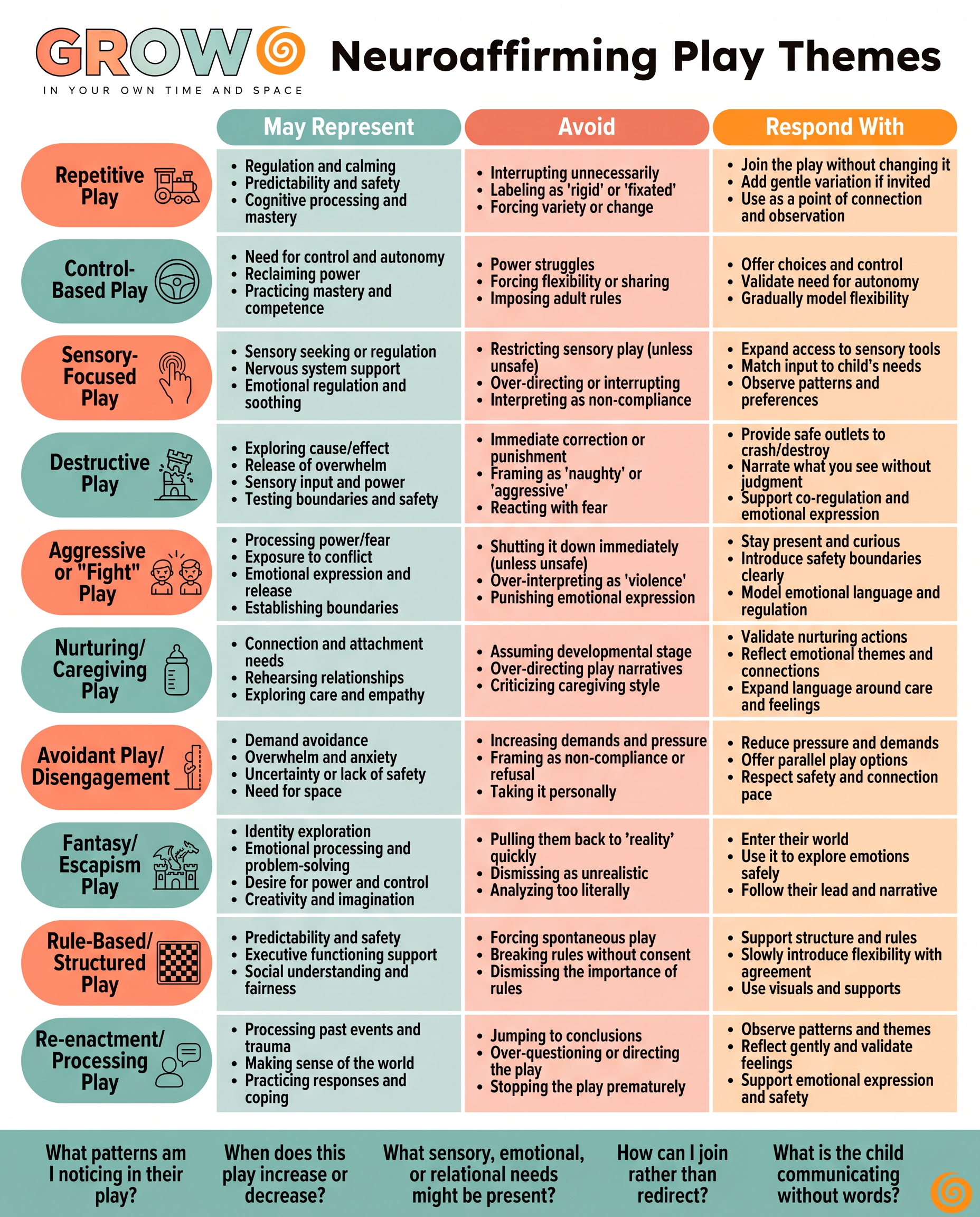
The GROW™ Neuroaffirming Play Themes Guide helps parents, therapists, educators, support workers, and early childhood professionals move beyond surface-level interpretations of play and develop a deeper understanding of the needs, emotions, and communication that may be sitting underneath a child's play experiences.
This practical visual guide explores common play themes including:
• Repetitive Play
• Control-Based Play
• Sensory-Focused Play
• Destructive Play
• Aggressive or "Fight" Play
• Nurturing and Caregiving Play
• Avoidant or Disengaged Play
• Fantasy and Escapism Play
• Rule-Based and Structured Play
• Re-enactment and Processing Play
For each play theme, the guide outlines:
✓ What the play may represent
✓ Common adult responses to avoid
✓ Neuroaffirming ways to respond
✓ Reflection questions to support observation and understanding
Rather than asking, "How do I stop this behaviour?", this resource encourages adults to become curious and ask:
"What is this child communicating?"
Perfect for:
- Developmental Educators
- Behaviour Support Practitioners
- Occupational Therapists
- Speech Pathologists
- Play Therapists
- Educators and Education Assistants
- Early Childhood Professionals
- Support Workers
- Parents and Carers
Whether used in therapy sessions, classrooms, parent coaching, supervision, or professional development, this guide provides a practical framework for understanding play as communication and supporting children through connection rather than correction.
Part of the GROW™ Framework – Understanding Behaviour Through a Neuroaffirming Lens.
Product Details
- Format: PDF Download
- Pages: 1
- Suitable for: Professionals, educators, parents and carers
- Use: Therapy sessions, parent coaching, supervision, professional development, classroom support, behaviour support planning
- Framework: GROW™ Neuroaffirming Practice Framework
